



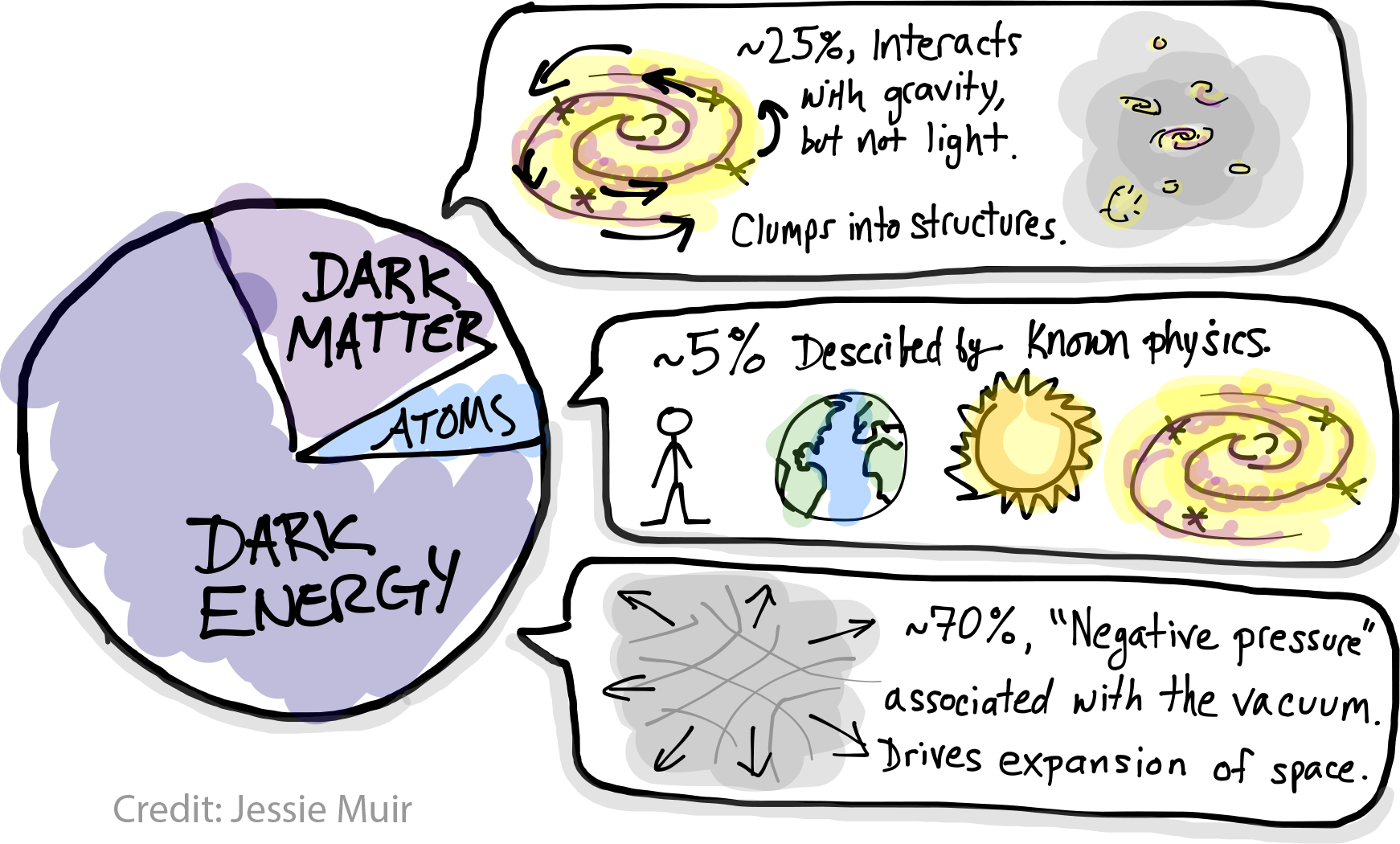
Dark matter
In 1933, the Swiss astronomer observed the movement of galaxies in the Coma cluster. He used something called the Virial theorem, which relates the kinetic energy of a system (the energy of motion) to the gravitational potential energy (the energy stored due to an object's position in a gravitational field) of the same system. He calculated the kinetic energy from the observed velocities of the galaxies, and from there could estimate the gravitational energy and hence the mass of cluster. He then compared this mass to an estimate bassed on the average mass-to-light ratio of galaxies (essentially counting the number of stars based on the luminosity of the galaxies). He found that the results of these two methods of calculating the mass differed greatly! Based on the virial theorem, there should be a lot more mass in the cluster than based on just the visible mass! He reffered to this missing as dunkele materie, german for dark matter.
Gravitational lensing
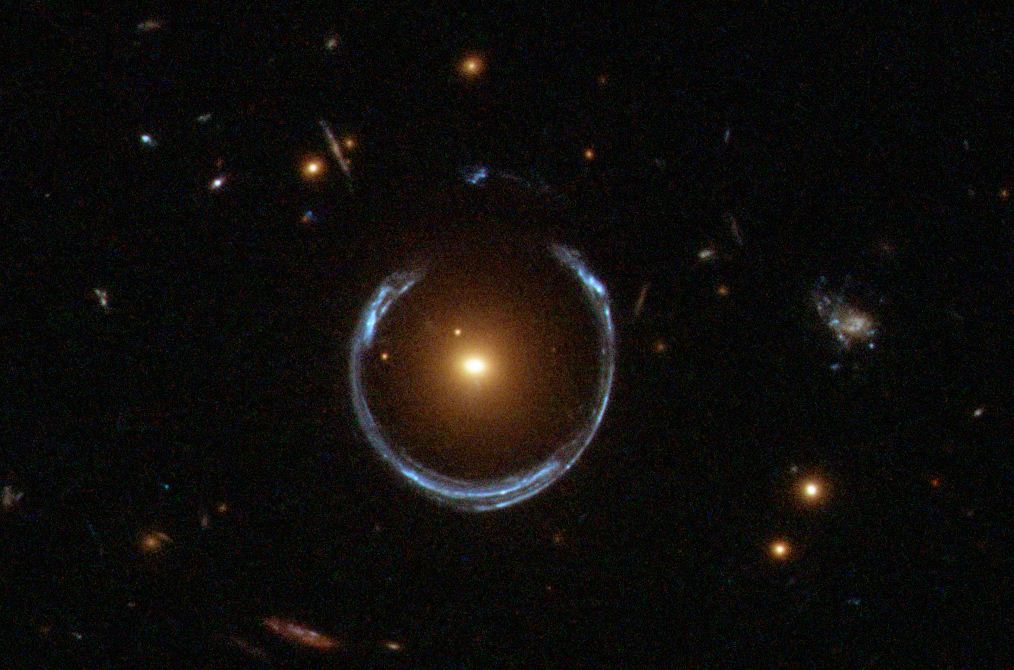
Similar to an optical lens, a gravitational lens bends light from a distant source as it travels towards the observer. When the distortions are visible, we refer to this phenomenon as strong gravitational lensing. An example of strong gravitational lensing is shown in the image below. A red galaxies is almost directly in front of a blue galaxy in the background. As a result the light from the further is distorted into an (almost perfect) ring around the foreground galaxy. This particular type of distortion is called an Einstein ring.
SuperBIT
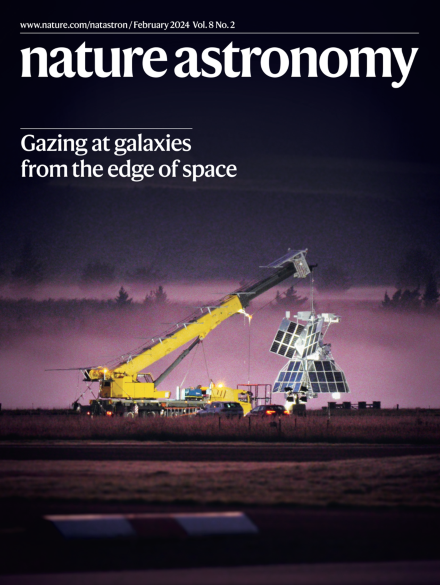
The Super-pressure Balloon-borne Imaging Telescope, also known as SuperBIT, is a highly-stabilized, high-resolution telescope that operates in the stratosphere via NASA's super-pressure balloon system. At 40 km altitude above sea level, the football-stadium-sized balloon carries SuperBIT to a suborbital environment above 99.2% of the Earth's atmosphere in order to obtain space quality imaging. As a research instrument, SuperBIT's primary science goal is to provide insight into the distribution of dark matter in galaxy clusters and throughout the large scale structure of the Universe.
In 2023, SuperBIT had its first ever fully-operational science flight. It launched on the 16th of April, and came down on the 24th of May, having circumvented the southern hemisphere six times.
Cosmological simulations
Cosmological simulations are an important tool to help us understand what is going on in the Universe.